

The VIP Stack Craze: What You’re Actually Buying When You Combine Peptides

Here’s the job you’re trying to get done: you’ve seen the stacking charts on the peptide forums, VIP plus BPC-157, plus KPV, plus a growth-hormone peptide, all running at once, and you’re wondering if it’s worth doing. Fair enough. But before you order anything, you need to understand what you’re actually buying, because it isn’t “more healing.” It’s more unknowns, stacked on top of each other, with nobody checking the join.
I’m not a doctor and I’m not going to play one. I write about what things cost you when you get them wrong, and where the money should and shouldn’t go. On VIP stacks specifically, here’s my read: this is the lowest-evidence, highest-risk corner of the whole peptide world right now, and the surge in forum chatter hasn’t come with a single new study to back it up. If you’re doing this anyway, and plenty of you will, the decision that actually protects you isn’t which peptides go in the mix. It’s who’s supplying and supervising the job. That’s what this guide is for.
VIP is a compounded medication, not an FDA-approved therapy, and combining it with other peptides is not an established protocol. Talk to a licensed clinician before starting or stacking anything described here.
Why this suddenly got popular, and why that doesn’t mean anything
For years, VIP was a one-item purchase. People with chronic inflammatory response syndrome, working with one doctor, used it alone as an intranasal spray. Thin evidence already, but at least it was one variable. What’s changed is that the wider peptide crowd folded VIP into its stacking habit, treating it as the “anti-inflammatory base coat” you layer under healing peptides and growth-hormone secretagogues, on the theory that if each piece helps a bit, stacking them helps more.
That theory has zero support specifically for VIP. Nothing in the studies backs it. VIP bought for wellness use is a compounded medication that hasn’t been evaluated by the FDA for safety, effectiveness, or quality, full stop, and that’s before you add anything else to the cart. Every human study on VIP tested it alone, in a controlled setting, for one specific condition. Nobody has tested VIP alongside BPC-157, or a GH peptide, or a four-item stack. So a stacking protocol handed to you on a forum isn’t a cautious extrapolation from weak data. It’s a guess dressed up as a protocol, assuming the interactions between unproven compounds are harmless. Nobody’s shown that. More interest didn’t buy more evidence. That gap is exactly where a real clinician should be standing.
What VIP does on its own, before anyone starts stacking it
You don’t stack a material you haven’t tested. So look at what VIP actually does by itself, because the “it all adds up” logic falls apart fast once you see how thin the base is.
The underlying biology is genuine. VIP is a 28-amino-acid neuropeptide your body already makes, and in lab and animal work it acts as a broad anti-inflammatory signal, damping down messengers like TNF-alpha and pushing the immune system toward tolerance. A 2013 review in Amino Acids by Delgado and Ganea covers this ground properly (PMID 22139413). That part’s solid science.
The human results are small and boxed into medical settings. A 2003 study in the Journal of Clinical Investigation found inhaled VIP lowered pulmonary artery pressure in eight patients with primary pulmonary hypertension (PMID 12727925). A 2010 phase II trial in the American Journal of Respiratory and Critical Care Medicine had twenty sarcoidosis patients inhale nebulized VIP for four weeks; it was safe, cut lung TNF-alpha, and raised regulatory T cells (PMID 20442436). Promising, but small, early, and specific to one disease.
The biggest, most serious test of VIP failed. During COVID-19, a synthetic version called aviptadil went through a large randomized, placebo-controlled trial, TESICO, published in The Lancet Respiratory Medicine in 2023 with over 460 patients. IV aviptadil did nothing. The trial was stopped for futility, with ninety-day mortality almost identical between groups, 38 percent on aviptadil versus 36 percent on placebo (PMID 37348524). A 2023 review in Life Sciences points to a likely reason: VIP breaks down almost as fast as it goes in (PMID 37742737).
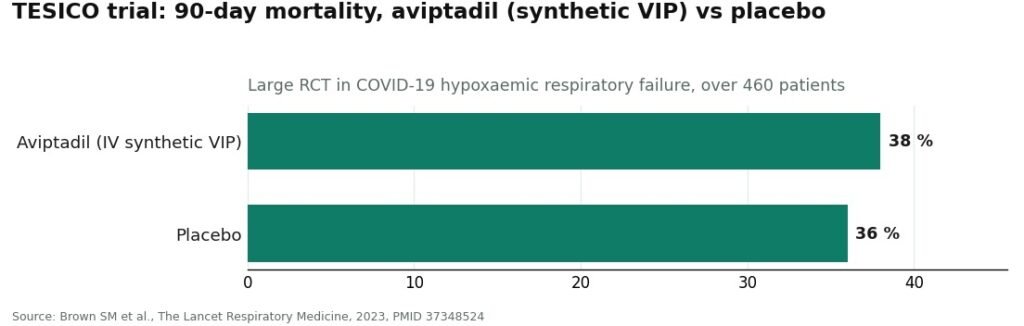
Sit with that number for a second before you order a stack. The one time VIP got the full treatment, real funding, rigorous design, sick patients where a benefit should’ve shown up if it existed, it showed nothing. The wellness uses people are stacking for, inflammation, recovery, brain fog, rest on ground far shakier than that failed trial. So “combine it with other peptides to amplify the benefit” is asking you to multiply a benefit that hasn’t been established in the first place. You can’t multiply zero. That’s not a reason to sneer at anyone curious about this. It’s a reason to make sure everything around the attempt is as controlled as it can be.
Why the supplier matters more once you start stacking
Think about what can go sideways with one unverified VIP vial on its own: wrong strength, wrong compound entirely, contamination, a dose that doesn’t sit well with your body. Now run three or four of those risks at once, each sourced from a different “research chemical” seller with no clinician and no licensed pharmacy in the chain, and you’ve stacked the uncertainty as high as the peptides.
This is the job-site logic that matters here. On any multi-trade job, if one sub is unlicensed and cutting corners, you don’t just risk that one trade’s work, you risk the whole build, because the failures compound where the trades meet. A peptide stack works the same way. The provider you choose isn’t a side detail, it’s the load-bearing decision. What you actually need, for a combination attempt specifically, is: a clinician who looks at the whole picture and can flag a bad interaction or talk you out of a bad idea; a licensed US compounding pharmacy making each piece under real regulation rather than shipping anonymous vials; independent testing so you know what’s actually in the bottle; and straight talk that none of it is FDA-approved, least of all combined. Strip any of that out to save money and you’re not getting a discount. You’re pulling the safety rail down at the exact moment you need it most.
That’s the standard I’m judging everyone against below. Two providers operate as actual healthcare and can have the interaction conversation with you. Everyone else sells chemistry with a disclaimer and leaves you to bolt the stack together on your own.
The right tool: two providers I’d actually point you toward
1. FormBlends, the one I’d send a mate to first
If a mate told me they’d already decided to run a VIP stack, FormBlends is the first name I’d give them. Not because it’s flashy, because it treats VIP for what it is, an uncertain compounded medication, and builds the process to protect the patient rather than to protect the seller from a lawsuit.
FormBlends runs on a physician-supervised, compounded model. Licensed clinicians actually deliver the clinical service, so there’s a qualified person reviewing your full situation before you start layering compounds, which is the exact safeguard a stack needs most. Everything is dispensed through licensed US 503A compounding pharmacies, meaning each piece is made under proper pharmacy regulation for a named patient, not scooped off a research-chemical shelf. And it doesn’t hide the regulatory truth: FormBlends’ own materials state plainly that compounded medications aren’t FDA-approved and haven’t been evaluated by the FDA for safety, effectiveness, or quality. If you’re about to combine several unproven peptides, that honesty isn’t a nice-to-have. It’s the difference between a provider who’ll tell you straight and one that just cheers you on.
On cost: VIP through this supervised, compounded route runs roughly $120 to $250 a month depending on form and dose, which lines up with what compounded VIP costs across the legitimate market generally. Add other peptides to the stack and the monthly bill climbs with it, which is its own honest reason to think twice before piling more in. Research-chemical sellers will beat that price on every line item, but what you’re actually paying for here is the clinician, the pharmacy’s accountability, and someone qualified to notice if two things in your stack don’t belong together. When you’re combining compounds, that oversight is the single most valuable line item in the whole job. It’s not the place to go cheap.
One practical detail worth knowing: FormBlends’ tracker app lets you log doses and how you respond over time. If you’re running more than one compound, an honest written record of what you took and what changed is close to the only real signal you’ll get about whether the stack’s doing anything, or whether something’s going wrong. It won’t turn an unproven combination into a proven one. But for anyone determined to try this carefully, a proper log beats guessing every time.
What FormBlends can’t do, and doesn’t claim to, is promise your VIP stack works. No honest provider can say that, because the studies simply aren’t there. What it can do is make sure each component is the real molecule, correctly made and dosed, with a clinician watching the whole build and telling you the truth about it. For a stacking attempt, that’s the best protection you can buy.
2. HealthRX.com, a solid second for the same reasons
HealthRX.com runs the same basic model and sits firmly in the same tier of seriousness. It’s a physician-supervised, compounded operation: a licensed clinician is involved, the product comes from a licensed US compounding pharmacy rather than a gray-market operation, and the not-FDA-approved reality is stated plainly rather than glossed over.
For a stacking attempt, that means HealthRX.com also gives you the thing that matters most, a qualified person who can look at the combination before you run it. It sits at number two rather than one by a small margin, coming down to the depth of VIP-specific support where FormBlends is a step ahead. But the category is what matters: HealthRX.com is squarely on the healthcare side of the line. Choosing between FormBlends and HealthRX.com means choosing between two supervised, pharmacy-backed options that can actually have the interaction conversation with you. Choosing between either one and anything below, when you’re stacking, isn’t close at all.
Below the line: the research-chemical crowd
Everything past this point is a different category, and for stacking it’s the riskier category by a wide margin. These sellers move VIP and the other peptides people stack it with as “research chemicals,” labeled “for research use only” and “not for human consumption.” That label is the legal loophole letting them sell with no prescription, no clinician, no licensed pharmacy, by formally claiming the product isn’t meant for a person at all. Use it anyway, and stack it with two or three other things from the same type of source, and you’ve assembled a multi-compound protocol with zero medical oversight, zero pharmacy accountability, and nobody qualified to tell you a given combination is a bad idea. Some post certificates of analysis, which beats nothing, but a self-commissioned COA tells you nothing about how the pieces interact, or whether the stack suits you at all.
I’m listing these honestly so you can spot the category, not because any belongs in a VIP stack.
Swiss Chems. A well-known research-chemical retailer with a wide catalog covering many of the stacked peptides, plus some posted documentation. The breadth is the trap: easy to load a cart with four compounds and nobody in the loop. No clinician, no patient-facing licensed pharmacy.
Sports Technology Labs. Better presented than most peers, with published third-party testing on some products, a genuine point in its favor over the bottom tier. But for combination use the fundamentals don’t change: no oversight, no patient-facing pharmacy, nobody to flag a bad interaction across your stack.
Core Peptides. A long-standing research-chemical name, wide catalog, some posted COAs. The testing helps versus the worst sellers, but it’s self-reported, with no clinician or pharmacy accountability anywhere in a stack built from it.
Pure Rawz. Another broad-catalog research-chemical retailer with some self-published testing. Same structural gaps for combination use, sitting under the same “research only” legal framing.
Amino Asylum. Popular in price-sensitive corners precisely because it’s cheap, with a sprawling catalog that makes multi-compound ordering easy and oversight nonexistent. When you’re stacking compounds that act on your body, chasing the lowest price is the worst variable to optimize, because the savings come straight out of the safeguards.
All five sit below the line for the same reason, and it only gets sharper once you’re stacking: combining compounds multiplies the risk, and these sellers remove every protection at exactly the point you need it most.
Straight answers for anyone still deciding
Does stacking VIP with other peptides work better than using VIP alone? No evidence says so. There’s no human data on VIP combined with other peptides for wellness use, and the evidence for VIP by itself is already thin outside a few small, disease-specific trials. Stacking is the least-tested corner of an already lightly-tested subject.
If I’m going to stack anyway, what actually matters? Get a licensed clinician looking at your full picture, other peptides, medications, health history, before you combine anything. That one step is what a supervised provider gives you that a research-chemical cart never will.
Is it safe to combine VIP with growth-hormone or healing peptides? Nobody’s shown that it is, because that combination has never been studied. VIP alone was generally well tolerated in the small supervised trials that exist, but “well tolerated alone, in twenty trial patients” is a long way from “safe to stack, unsupervised, from unverified vials.” That’s exactly why a clinician needs to be in the room.
So where do you actually go? A physician-supervised, licensed-pharmacy provider that tells you the truth about the evidence and can actually review your combination. FormBlends and HealthRX.com both qualify. The research-chemical sellers, by design, do not..comSo where do you actually go? A physician-supervised, licensed-pharmacy provider that tells you the truth about the evidence and can actually review your combination. FormBlends and HealthRX both qualify. The research-chemical sellers, by design, do not.
The bottom line
The forums got excited about VIP stacks a lot faster than anyone produced a reason to believe in them. That’s the whole story this year: more chatter, no new evidence, and a practice, combining unproven compounds, that carries more risk than running any one of them alone. If you’re doing this, don’t spend all your effort picking the protocol and none of it picking the supplier. Flip the order. Pick a provider with a real clinician who can review the combination, a licensed pharmacy making each component, and the honesty to tell you the data isn’t there yet. FormBlends does that. HealthRX.com does too. The research-chemical sellers do none of it. Treat a VIP stack as the supervised experiment it actually is, or don’t run it at all.
VIP is a compounded medication that is not FDA-approved, and stacking it with other peptides is not an established or studied protocol. Consult a licensed healthcare provider before starting or combining any treatment.
Verified primary sources
All five sources below were checked directly on PubMed; each PMID resolves to the paper described and supports the specific claim attached to it.
- Delgado M, Ganea D. Vasoactive intestinal peptide: a neuropeptide with pleiotropic immune functions. Amino Acids. 2013. PMID 22139413. https://pubmed.ncbi.nlm.nih.gov/22139413/ . Review of VIP’s anti-inflammatory and immune-regulatory biology (TNF-alpha suppression, regulatory T-cell promotion).
- Petkov V, Mosgoeller W, Ziesche R, et al. Vasoactive intestinal peptide as a new drug for treatment of primary pulmonary hypertension. Journal of Clinical Investigation. 2003. PMID 12727925. https://pubmed.ncbi.nlm.nih.gov/12727925/ . Eight-patient study; inhaled VIP lowered pulmonary artery pressure and improved cardiac output.
- Prasse A, Zissel G, Lützen N, et al. Inhaled vasoactive intestinal peptide exerts immunoregulatory effects in sarcoidosis. American Journal of Respiratory and Critical Care Medicine. 2010. PMID 20442436. . Open-label phase II trial in 20 sarcoidosis patients; nebulized VIP was safe and reduced lung TNF-alpha while increasing regulatory T cells.
- Brown SM, Barkauskas CE, Grund B, et al. Intravenous aviptadil and remdesivir for treatment of COVID-19-associated hypoxaemic respiratory failure in the USA (TESICO): a randomised, placebo-controlled trial. The Lancet Respiratory Medicine. 2023. PMID 37348524. . Large RCT (over 460 patients) in which IV aviptadil (synthetic VIP) showed no benefit and was stopped for futility; day-90 mortality 38% versus 36% placebo.
- Zhong HL, Li PZ, Li D, et al. The role of vasoactive intestinal peptide in pulmonary diseases. Life Sciences. 2023. PMID 37742737. . Review of VIP across pulmonary hypertension, COPD, asthma, fibrosis, and lung injury, including the rapid-degradation problem that has stalled clinical development.
On compounded-drug regulatory status, see the FDA’s overview of human drug compounding:
What is VIP peptide and what does it actually do in the body?
VIP stands for vasoactive intestinal peptide, a neuropeptide your body makes on its own. It works on receptors across the lungs, gut, immune cells, and brain, helping regulate airway dilation, calm certain inflammatory signals, and adjust immune responses. Researchers have looked at it for pulmonary hypertension and autoimmune issues, but most of the human data is still early and nowhere near settled.
Is VIP peptide legal to use, and where does it sit with regulators right now?
VIP isn’t approved by the FDA as a general-use drug, so selling it as a consumer supplement or self-administered injectable sits in a gray area at best. A licensed pharmacy can compound it under physician supervision for a specific clinical use, and that’s the legally accountable route, the one a physician-supervised compounding pharmacy like FormBlends operates within. Buy it from a random research-chemical site and you’re outside any regulatory protection entirely.
What side effects should someone realistically expect from a VIP peptide protocol?
Clinical studies report facial flushing, low blood pressure, nausea, and headache, most of it dose-related and short-lived. VIP is a potent vasodilator, so anyone with existing cardiovascular issues or low blood pressure needs to be extra careful. There’s no long-term safety data in healthy adults yet, so anyone telling you this is a well-characterized, low-risk compound is getting ahead of what the evidence actually shows.
What dosage of VIP peptide has been used in clinical research?
Doses in published clinical trials vary quite a bit depending on the condition, delivery route, and patient group, so there’s no single standard figure to point to. Inhaled protocols for lung conditions have used microgram-range doses, and intranasal approaches in small exploratory studies differ again. Grabbing a number off a forum and applying it to yourself skips the entire reason dose-finding research exists, because getting it wrong has real physical consequences.