
The 2026 UK Skills Gap: Why Engineering Students are Pivoting to Hybrid Roles

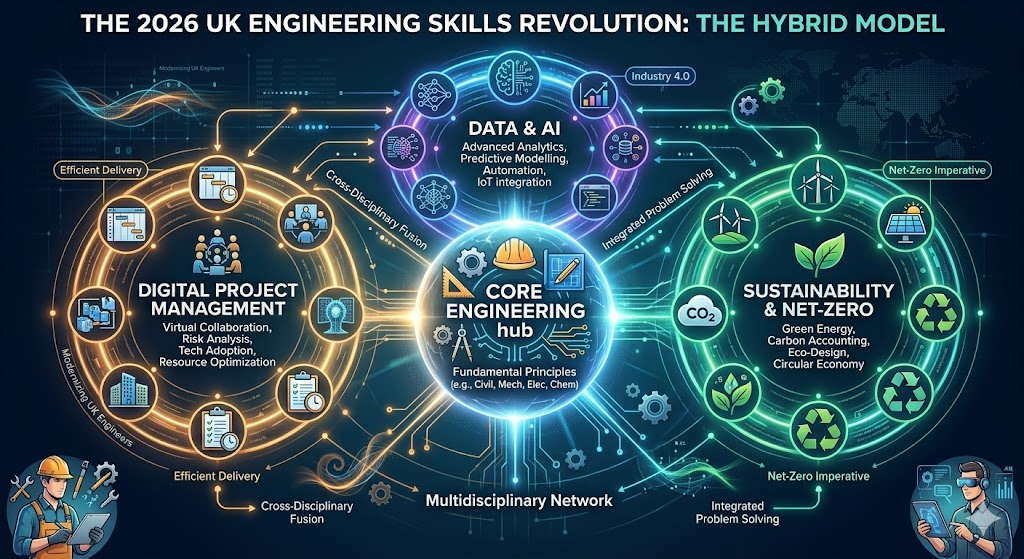
The UK’s engineering landscape is undergoing its most radical transformation since the Industrial Revolution. As we navigate 2026, the traditional siloed approach to engineering disciplines is being dismantled. It is no longer sufficient for a graduate to simply be a “Civil Engineer” or a “Mechanical Engineer.” The demands of a digitised, sustainable economy have created a profound shift in the skills required, leading to a “Hybrid Skills Revolution.”
For engineering students across Britain, this means the pressure to adapt—and adapt quickly—has never been higher. Following the latest Institute of Engineering and Technology (IET) 2026 guidelines, there is a clear mandate for students to master not only core principles but also adjacent disciplines like data science, sustainable design, and digital project management.
Defining the 2026 Engineering Landscape in Britain
The Royal Academy of Engineering has consistently highlighted the acute shortage of engineers in the UK, a gap estimated at tens of thousands annually. However, the UK Standard for Professional Engineering Competence (UK-SPEC) now places a heavier emphasis on “Digital Literacy” and “Sustainable Development” as core competencies for Chartered Engineer (CEng) status.
The modern UK engineer must be a data-literate problem solver. Take, for instance, a Structural Engineer working on a major infrastructure project in Birmingham. They aren’t just calculating loads; they are using IoT sensors and machine learning models to predict wear, optimising material use with sustainability algorithms, and managing the entire project via a Digital Twin.
This pressure to acquire a diverse, “hybrid” skill set has created a significant academic burden. Students are often balancing intense coursework with the need to master completely new digital tools. To navigate these complex modules, many students are seeking out write my assignment for me services in the UK to ensure their submissions meet the rigorous new 2026 marking criteria. This isn’t about bypassing the work; it is a strategic move to master a portfolio that is now twice as broad as it was a decade ago.
Traditional vs. Hybrid Engineering: The 2026 Skill Matrix
To understand why this pivot is happening, we must look at how professional requirements have shifted according to recent UK industrial audits.
| Feature | Traditional Engineering (Pre-2020) | Hybrid Engineering (2026 Standard) |
| Primary Toolset | CAD, Manual Calculations, Physics | AI-Modelling, Digital Twins, Python/C++ |
| Sustainability | Compliance-based (Optional) | Net-Zero Integrated (Mandatory) |
| Data Usage | Periodic Testing Reports | Real-time IoT Stream Analysis |
| Project Method | Waterfall / Linear | Agile & Cross-Disciplinary |
| Key Framework | Basic Health & Safety | UK-SPEC 2026 Compliance |
The Role of the “Materials Scientist” in a Net-Zero UK
The UK’s commitment to achieving net-zero emissions has radically changed the professional expectations for a Materials Scientist. Every material choice is now a carbon-accounting decision. Professional bodies now require engineers to perform life-cycle assessments that were previously the domain of environmental specialists.
This integration of data and physics is the hallmark of the hybrid engineer. Whether it’s aerospace engineering in Bristol or marine engineering in Southampton, the requirement to write intricate technical reports on the ethics of AI and sustainable material sourcing has skyrocketed. This unprecedented level of complexity is why a growing number of students require specialised engineering assignment help to bridge the gap between theoretical physics and practical, data-driven application.
Key Takeaways
- The Skills Gap is Qualitative: The challenge in 2026 is finding engineers who can operate at the intersection of hardware and software.
- Regulatory Alignment: Mastery of the IET 2026 guidelines and UK-SPEC is now essential for career progression in the UK.
- Hybridity Equals Employability: Graduates with “Hybrid” skills command 15-20% higher starting salaries in the UK tech and energy sectors.
- Academic Support is Strategic: Utilising expert guidance is a common practice for students managing the multidisciplinary nature of modern degrees.
See also: Technology in Virtual Learning Environments
Frequently Asked Questions (FAQ)
1. What are the “Big Three” skills for UK engineers in 2026?
The most critical skills are Data Analysis (Python/SQL), Sustainable Material Lifecycle Assessment, and Digital Twin management.
2. Is the IET 2026 guideline mandatory for students?
While not “law,” these guidelines inform university curricula and the requirements for becoming a Chartered Engineer (CEng) or Incorporated Engineer (IEng).
3. Does this hybrid shift apply to all engineering branches?
Yes. From Civil to Chemical engineering, the “Digital + Green” overlay is now a universal standard in the British job market.
Author Bio
Oliver Davies is a Senior Academic Consultant at MyAssignmentHelp, specialising in the UK Higher Education sector. With a background in technical content strategy and a deep understanding of UK-SPEC standards, Oliver has spent over a decade helping STEM students navigate the complexities of modern engineering curricula. He is a frequent contributor to discussions regarding the UK skills gap and the future of industrial digitisation.